ACT Toolkit
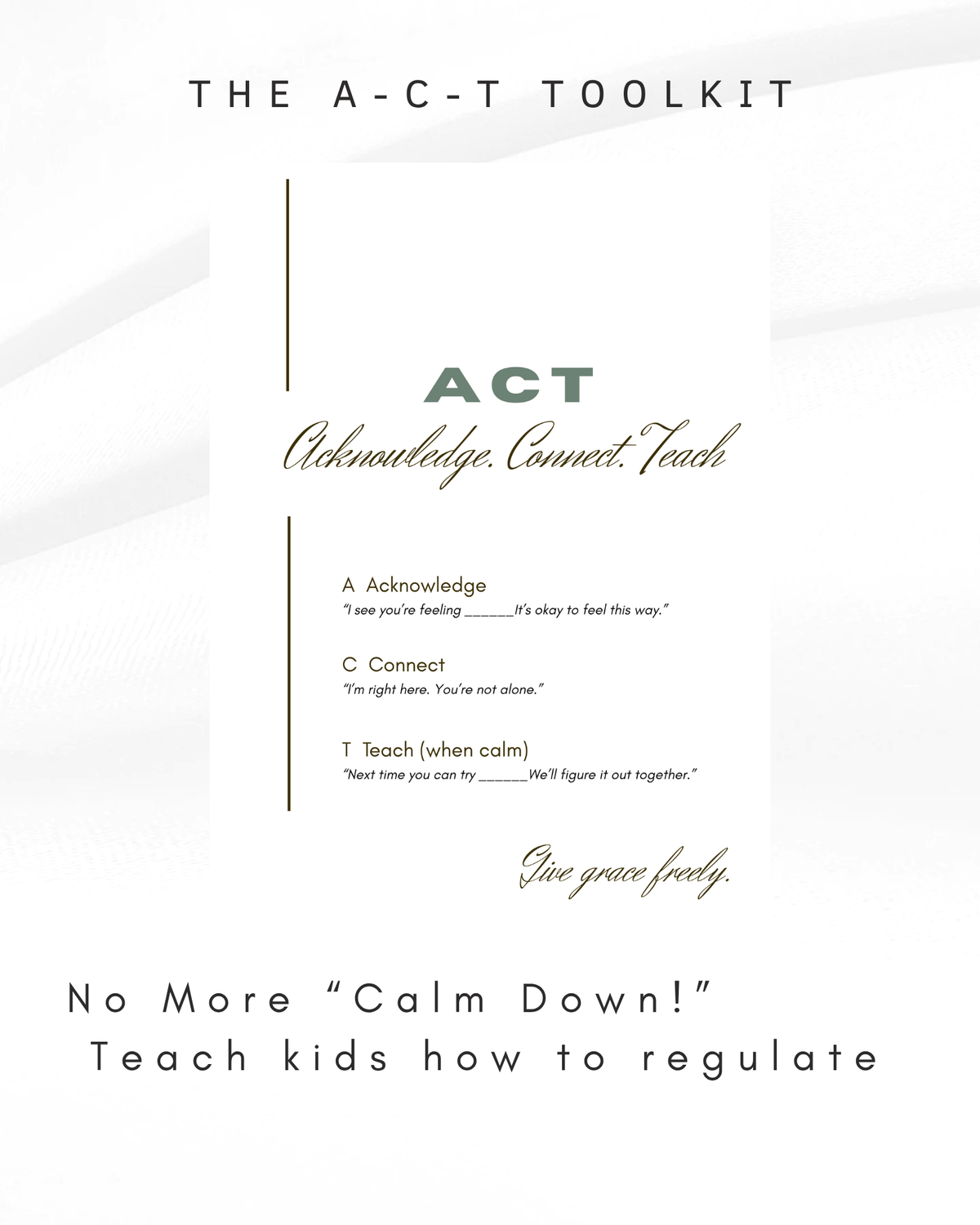
Acknowledge - Connect - Teach
When a child is upset, especially a child who struggles with ADHD, trauma, executive dysfunction, autism, ODD, or PDA, our instinct is often to correct the behavior immediately.
But dysregulation is often not defiance.
It is overwhelm.
That is where ACT comes in.
Acknowledge. Connect. Teach.
This simple three step approach helps de-escalate big emotions while keeping relationship at the center.

Acknowledge the Feeling
Before anything else, name what you see.
"You are feeling really frustrated right now."
"It is okay to feel angry."
"I see that you are having a hard time."
The goal is not to approve of behavior. The goal is to validate emotion.
Children who are neurodivergent or trauma impacted often experience feelings more intensely and may struggle to identify them. When you calmly name the emotion, you help bring structure to internal chaos.
Acknowledging communicates safety. It says I see you. You make sense. You are not bad. You are overwhelmed.
Often that alone begins to lower the intensity.
Connect
Once the feeling is acknowledged, offer calm presence.
"I am right here with you."
"You are not alone."
"Let us take a breath together."
"I have felt that way before too."
Connection regulates.
When a child is dysregulated, their nervous system is activated. Logic will not land yet. Consequences will not teach yet. Lectures will not stick.
Connection signals safety to the brain, and safety allows the body to settle.
For children with trauma histories or demand avoidant tendencies, connection reduces the threat response that can show up as opposition, shutdown, or escalation.
Teach When They Are Ready
This step comes after calm has returned.
Not during the meltdown.
Not when voices are raised.
Not when everyone is flooded.
Later, you might say:
"Next time you can try asking for a break."
"What could we do differently?"
"How can I help you next time?"
Now you are building coping skills.
You are teaching regulation rather than punishing emotion.
For children with ADHD or executive dysfunction, this is where we scaffold tools. For autistic children, this is where expectations can be clarified. For children who lean oppositional or struggle with demand avoidance, collaboration reduces power struggles.
Teaching works best after connection.
Why ACT Works
Typically we believe children do well when they can. When they cannot, they need support, not shame.
ACT shifts the focus from stopping behavior to understanding what the child needs in that moment.
Regulate first. Then educate.
Connection opens the door for learning.
This approach does not mean permissive parenting. It does not remove boundaries. It simply prioritizes the nervous system before correction.
For many neurodivergent, trauma impacted, or emotionally intense children, that shift changes everything.
If this ACT visual has been helpful for your home or classroom, I created it as part of a larger emotional regulation support package available in my Etsy shop, Pixel and Praise.
The full bundle includes additional resources, printable supports, and practical tools designed to create a cozy corner and help children build coping skills in a calm, connected way.
This resource was created out of real-life need, shaped by my experience as both a parent and educator. My hope is that it supports you in building connection first and teaching second, especially in those moments that feel overwhelming.
Check out the Full Behind the Behaviour Toolkit Bundle